I’ve never seen I.A. Richards claimed as an Anarchist.
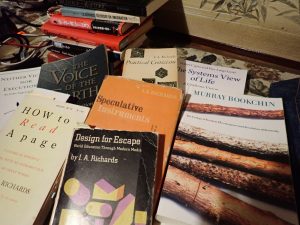
Teaching English became worthwhile after I discovered the Graded Direct Method; GDM was developed by I.A. Richards. I came to GDM, from Paul Goodman, that practical anarchist, author of Growing up Absurd. Yuzuru Katagiri translated Paul Goodman’s title to 「不条理に育つ」(FuJouRi ni SodaTsu). The translator’s notes mentioned that Yuzuru Katagiri wrote poetry against the U.S.A. war in Vietnam. The afterword and ending blurbs may have mentioned that he also translated Aldous Huxley’s Island and other interesting books.
An interest in the Growing Up Absurd‘s translator had me searching on-line for pages about Yuzuru Katagiri. I saw that he lived in Kyoto and trained teachers to work with the Graded Direct Method and English Through Pictures(1945). I was able to meet the translator and start attending GDM seminars. Getting stared with GDM is grueling. Choreographing the sequence of situations that will illuminate the sentences is hard. More time is needed to sequence drawings that further illustrate the sentences. For the first few years, you need a lot of time to get your tools, not only large-size drawing paper and magnets, but also the various things (clear bags and boxes and various “realia”) for use during the first, live-situation part of the class. The effort requires some sort of mix of at least two elements, time and motivation. Finding the motivation to dedicate time and effort can be challenging today. The thinker bell hooks writes of teaching as a caring profession and how caring is seen as low status in modern industrial society and the present day university. But reading I.A. Richards gets you thinking back to Plato who saw the classroom as a great laboratory. Paul Goodman mentions that John Dewey thought that Education was the main trunk of philosophy, all other fields are merely branches. Understanding that comment is helped by I.A. Richards’s discussions about our need to choose what sort of persons, what sort of humanity we want to become.
… the endless arch-inquiry: What are we and what are we to become? — I.A. Richards “Poetry as an Instrument of Research” Speculative Instruments p.154
The essays in the book Speculative Instruments may become more understandable after reading Roszak’s Voice of the Earth: An Exploration of Ecopsychology and Fritjof Capra’s The Systems View of Life: A Unifying Vision. I’m starting to catch up with Neil Bohr’s ideas.
Language has an annoying way of anticipating our utmost intellectual flights with smooth and effortless puns. All meanings are means, are instruments, and inside “instrument” it is somewhat more than a pun if we find “Instruction”, since it is through instruments that we form problems. If so the super-problem is to find means of making the greatest possible variety of means available: the widest and freest choice of instruments. For instruments enter into the work and shape not only the success attained but also the end pursued. It may be hoped that, with further study, these dependencies of the problem upon the instruments through which it is set will become clearer. And then the relation of these instruments to those through which the problem can be replaced would come forward. What has been lacking may have been the freedom in the development of the instruments needed for this super-problem.
… Might not that condition… in which words… are still as yet free to experiment with on another as to which meanings they may jointly support, the condition which arbitrarily named ‘Poetry’, be found useful—if only by slowing down our propensity to leap before we look—in finding us fresh Instruments all the way up toward the endless arch-inquiry: What are we and what are we to become?
Instruction and Usefulness are the two words which seem to have most to say about the work—giving things structure—of this graceful and luminous word. Useful instruction! What poetic and practical words! May I quote you a sentence I found this summer written up—above a door I used, many years ago, to go through daily—by a hand which seemed to have been mine: I had forgotten. It is from William Godwin, that singular anarchist, author of Political Justice:
— I.A. Richards “Poetry as an Instrument of Research” Speculative Instruments pp. 153-154
The remainder of my time I determined to devote to the pursuit of such attainments as afforded me the most promise to render me useful. — William Godwin
I wish I could recall doing something else about that beyond (so it appears) writing it up—over the emblem of our transitoriness.
I.A. Richards “Notes for a talk to a group of students of English” came to mind while reading Murray Bookchin’s “Thoughts on Libertarian Municipalism”. [1] Both speakers are concerned about the use of their remaining life. Murray Bookchin’s sentences urge me to go back to I.A. Richards’s Design for Escape: World Education Through Modern Media.
If citizens are to be competent to replace the State, then education for citizenship, or paideia, must be rigorous and involve the building of character and ethical integrity as well as gaining knowledge . This is even more the case when it comes to eliminating hierarchy. Rigorous education and training, in turn, involve a systematic, carefully planned, organized learning process. … It is precisely this concern for paideia that made Greek political philosophy so great: it included educational ideas for the making of competent citizens, who would not only think systematically but learn to use weapons in their own defense and in defense of the democracy. The Athenian democracy, let me note, was established when the aristocratic cavalry was replaced by the hoplite footsoldier—the civic guard of the fifth century BCE, which guaranteed the supremacy of the people over the formerly supreme nobility.
I.A. Richards’s sentences which came to mind while reading Murray Bookchin’s notes:
The sovereign incentive for all learning is the learner’s awareness of his own growing power. —I.A. Richards Desing for Escape (1968) p. 3
The gravest of all threats is from the growing lack of effective capability and not least of effectively capable teaching.
…
Technological advance call for larger numbers—a highly increased proportion—of effectively able people.
—I.A. Richards Design For Escape p. 5
Capability I think of as something that can be cultivated and developed—given the right opportunities and incentive. Effective is added to imply that the learner not only CAN, but in fact WILL, do what is needed. Too many able enough people find nothing useful to do.
Maybe technology, with free software will contribute to the free teaching needed for the effectively capable citizens Murray Bookchin envisioned.
[1]
- http://social-ecology.org/wp/1999/08/thoughts-on-libertarian-municipalism/