I’m not sure if I can make good use of a WordPress blog. But since autistici’s offerings (e-mail accounts and static web sites) are fascinating, I thought I’d try a NoBlogs site too.
I wonder if BuddyPress could replace Groupme for a family that wants to share text and image conversations privately?
Teaching English with The Graded Direct Method gets me thinking about the best use of different sorts of media. Some things are better learned through direct experience, other things may be easier to approach through visual presentations, and then some things are best grasped through written sentences.
I’ve been using Diaspora*, Pixelfed, and WriteFreely. [1] They all impress me. The Diaspora* community has been great, supportive: I learn a lot from people through my ruhrspora.de account. There are times when I want to share a picture don’t have enough leeway, or slack, to attend to the content and notifications of Diaspora*. That’s when quickly uploading photos to pixelfed is helpful. The WriteFreely blogs, just plain black and whiter, remind me of the textbook, English Through Pictures(1945) used for Graded Direct Method teaching. Maybe I’ll discover the most appropriate approaches, the best content for each platform: Diaspora*, PixelFed, WriteFreely, WordPress, and a static website.
I may have to focus on only one or two of the wonderful options though. There is only so much time in the day, and a lot of the time should probably be spent off-screen. Nicolas Carr’s The Shallows: What the Internet Is Doing To Our Brains got me thinking about ART: Attention Restoration Theory. We need to take time to enjoy nature, walk in the woods, or someplace where there is no advertising or machine noise. I think time in the garden works just as well as Forest Therapy.
Agroecology has fascinated me for a long time. I also have an old book called The Square Foot Garden. It’s been nice to experiment with a natural garden. I call it the Patchy Garden or Edible Meadow. The Ecoliteracy web site introduced me to the idea of an Edible Schoolyard, and this little patchy garden might serve as something like that. I get a lot of Sense of Wonder(Rachel Carson) out of it. The ladybugs and orb weaver spiders and all sort of living things seem to love it. I eat a lot of leaves out of it, and we enjoy soup from the squash too. Squash is so abundant it’s hard to eat it all, so jack-o-lanterns are fun too.
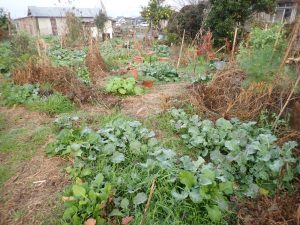
Patchy Garden or Edible Meadow
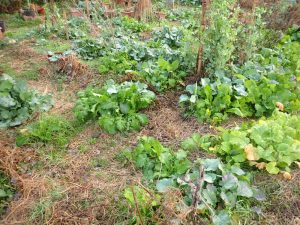
Patchy Garden, or Edible Meadow
Fritjof Capra is involved with the Ecoliteracy[2] site. His books The Tao of Physics and The Systems View of Life are giving me a lot to think about. They seem to be really good along with Theodore Roszak’s The Voice Of The Earth: An Exploration of Ecopsychology. The books are helping me to think about MinaMata水俣 and Pollution Disasters. A good Japanese term from Pollution Disaster is KouGai公害, a direct translation of the characters might be Public Damage. While reading Jun Ui[3] I’ve come to think of the KouGai as a compact way of saying Destruction of the Commons. A lot of great writing and work has been done in the face of Minamata’s EcoTragedy(Sean Michael Wilson).]4]
Living within a two hour drive of Minamata, and being able to read Japanese, I have to write about Minamata. I think the place, the small scale of the local geography lets us get a more concrete grasp on the large scale of our industrial destruction. Minamata lets us see the thinking of people like Michiko Ishimure and Masato Ogata. Their experience and thinking with Minamata Disease brings together important insights from Capra’s and Roszak’s writings. Later I have to look into Masato Ogata’s thinking with ideas from Albert Camus and Paul Goodman, but in the meantime these pages from Voice of the Earth keep coming to mind while I think of Minamata.
… the Utopian anarchism that Paul Goodman brought to prominence in the sixties. Goodman liked to refer to himself, somewhat impishly, as a conservative, on who cared most of all
“for green grass and clean rivers, children with bright eyes and good color whatever the color, people safe from being pushed around so they can be themselves. Conservatives at present seem to want to go back to conditions that obtained in the administration of McKinley. But when people are subject to universal social engineering and the biosphere itself is in danger, we need a more neolithic conservatism”
In contrast to the “phony conservatives” who continue to care more for the welfare of high rollers in the marketplace and the baronial corporations, Goodman took as his historical baseline the tribal simplicities of the prehistoric past. The result was a conservatism that reached so far beyond the empire of cities that it became the basis for a new radicalism. Goodman was through and through a New Yorker of intensely sophisticated tastes; yet like many romantic anarchists before him, he nursed a sincere if somewhat sentimentalized allegiance to bucolic folkways. His goal was to recapture these ancestral values within the context of the modern metropolis. Like E.F. Schumacher, he sought to achieve the “small” that is “beautiful” within the context of the big by way of decentralization and internal diversification. He felt this would be the cure not only for many of our political ills but for the crippling sense of powerlessness that is the peculiar psychopathology of industrial society. For Goodman, the ideal village for modern times would be something like Greenwich Village in its heyday, a colorful, lively community of artists and intellectuals blessed with cultural distinction and a decent amount of neighborhood autonomy within the otherwise suffocating bulk of greater New York.
In his effort to recapture the spirit of the neolithic within the high industrial order, Goodman was following the trail blazed by Prince Peter Kropotkin, whose discovery of intraspecies cooperation we have mentioned in chapter 5. Kropotkin’s place as one of the founders of modern ecology is widely acknowledged; he is among those who created the concept of the ecosystem. What is less recognized is the psychological theory that Kropotkin deduced from his studies and that qualifies him as among the first ecopsychologists.
Kropotkin was always careful to insist that the mutual aid he discerned among all living things was not primarily an altruistic virtue. It went much deeper. It was an instinctual, utterly spontaneous impulse welded into the foundations of animal consciousness and evolving throughout the history of life on Earth. The contrast with Freud could not be more dramatic. Based on his close, lifelong study of animals in the wild and the tribal societies of Siberia and Manchuria (a larger body of evidence than Freud every accumulated in his consulting room), Kropotkin concluded that human nature was fundamentally ethical; kinship and moral concern come to it as naturally as the song comes to the bird. At the foundations of the unconscious one finds conscience, the moral energy of the personality as firmly rooted in the psyche as patricidal jealousy or the death instinct—or possibly more so.
“It is not love and not even sympathy upon which society is based in mankind. It is the conscience—be it only at the stage of an instinct—of human solidarity. It is the unconscious recognition of the force that is borrowed by each man from the practice of mutual aid; of the close dependency of everyone’s happiness upon the happiness of all; and of the sense of justice, or equity, which brings the individual to consider the rights of every other individual equal to his own. Upon this broad and necessary foundation the still higher moral feelings are developed.”
For Kropotkin, the factor of innate conscience makes human community a great deal more than an agglomeration of people held together by a social contract. It is a biologically deep and intricate system. In contrast to the totalitarian regimentation that treats the populace as so many subordinate cellular unit of the body politic, Kropotkin would have a society of autonomous persons, each linked to each by ethical caring. — Theodor Roszak [The Voice of The Earth: An Exploration of Ecopsychology] pp.227-228
Masato Ogata talks about people taking care of each other, in a storm fisherfolk will tie their boats together もやい直しl for greater security. He also went mad for a bit. Theodor Roszak also mentions R.D. Laing arguing “that psychological breakdown could be the first step toward enlightened breakthrough. It might be the incipient assertion of true sanity by those who were still at least resilient enough to feel the pain of society’s oppression.” (p.55)
In The Systems View of Life: A Unifying Vision Capra and Luisi also quote R.D. Laing in one of their chapters about The Scientific Revolution:
To make it possible for scientists to describe nature mathematically, Galileo postulated,
as we have mentioned, that they should restrict themselves to studying only those properties
of material bodies – shapes, numbers, and movement – that can be measured and quantified.
Other properties, like color, taste, or smell, are merely subjective and should be excluded
from the domain of science. In the centuries after Galileo this became a very successful
strategy throughout modern science, but we also had to pay a heavy price. As the psychiatrist
R.D. Laing (quoted by Capra, 1988, p. 133) put it emphatically,” Galileo’s program offers us a dead world: Out go sight, sound, taste, touch, and smell, and along
with them have since gone esthetic and ethical sensibility, values, quality, soul, consciousness, spirit.
Experience as such is cast out of the realm of scientific discourse. Hardly anything has changed our
world more during the past four hundred years than Galileo’s audacious program. We had to destroy
the world in theory before we could destroy it in practice.” — Fritjof Capra and Pier Luigi Luisi in The Systems View of Life: A Unifying Vision
This post rambles, it’s not very coherent. It started out as my search for how to approach posting/presenting/communicating with WordPress. It ended up motivating me to search out and type in important passages from worthwhile books I’ve been reading lately. Maybe NoBlogs will help me settle down enough to write something worth contemplation.
[1] Other On-line Sharing Sites
- https://ruhrspora.de/u/bsmall2
- https://pixelfed.social/bsmall2
- https://wordsmith.social/bs2gdmteacher/
[2] EcoLiteracy
-
- https://www.ecoliteracy.org/article/alice-waters-applies-%E2%80%98delicious-revolution%E2%80%99-school-food
Wendell Berry has written that eating is an agricultural act. I would also say that eating is a political act, but in the way the ancient Greeks used the word “political” — not just to mean having to do with voting in an election, but to mean “of, or pertaining to, all our interactions with other people” — from the family to the school, to the neighborhood, the nation, and the world. Every single choice we make about food matters, at every level. The right choice saves the world. Paul Cezanne said: “The day is coming when a single carrot, freshly observed, will set off a revolution.” — Alice Waters
-
- https://www.ecoliteracy.org/article/thinking-ecosystem
Shifting from the mechanical assumption of separateness and seeing our societies as ecosystems, we get curious about how aspects interact. And, writes Oxford historian Theodore Zeldin, “It is only curiosity that knows no boundaries which can be effective against fear.”. . . — Frances Moore Lappé
[3] Jun Ui’s on-line book about Minamata
-
- archive.unu.edu/unupress/unupbooks/uu35ie/uu35ie0c.htm
Pollution problems are derived from a set of conditions that are related to health damage caused in the work environment; the effects of this are felt far beyond the industrial workplace in the form of health problems related to consumer goods. The problems extend outward from the factory, to the small circle of the community. and then to the larger circle of the nation – a process in which labour disasters’ pollution problems, and then consumer problems are all interconnected in a single nexus of cause and effect. — Jun Ui
[4] Minamata
- Graphic Novel:https://seanmichaelwilson.weebly.com/minamata-story.html
- Movie: https://www.imdb.com/title/tt9179096/?ref_=ttfc_fc_tt